The Concrete project,is a collection of installation performance art and documented footages from instagram direct posts‚ which shows a chronological timeline of uprising in Iran
woman life freedom


CONCRETE
Concrete confronts the hidden mass grave of Khavaran through photos of martyrs from the Woman, Life, Freedom uprising. Visitors are invited to break the concrete covering their images, to resist the Islamic regime’s attempt to bury truth. Each revealed face becomes an act of freedom, releasing forgotten souls and reminding us that resistance is the path to liberation.
Aida Roustami was a doctor in Iran. Outraged by the violence of the regime against Iranians protesting the murder of Mahsa Amini, Aida offered to treat injured protestors without denouncing them to the government forces intent on arresting anyone who turned out to share their anger and sadness. Aida died in police custody after days of torture, presumably because she would not share the names of her patients. She is one of the portraits in Sadaf’s exhibit. Like all the others, her portrait is covered in concrete, a 30x30cm gray square, bleak and void of any trace of what lies beneath. But this is not an exhibit of one death, rather of a mass campaign of terror. Rows and rows of gray, concrete squares fill the exhibit. A mass grave.
Majid Reza Rahnavard was a young man who had attended a protest. Riding in a car that was deemed suspicious by the notorious Basij police force, he was arrested and beaten. Leaving the courtroom after his death sentence was handed down, his broken arm in a sling and his eyes blindfolded, he responded to a reporter’s question that his final wish was that people would play happy music and dance by his grave. Majid Reza’s portrait is also a 30x30cm gray square. But there is joy in his eyes, and we discover that. In fact, all of the portraits are joyful and beautiful once they are revealed. The concrete falls away and while the death and the disappearance are still concrete, so is the joy and life in their eyes.
Mahsa Amini was not an activist or a protestor or a dissident. Mahsa Amini ran a small shop with her family. Her death was widely publicised because she was a religious woman wearing a veil- and because some of her hair was showing when she was arrested and subsequently died in police custody. Her death became the spark that set off the current explosion of anger shaking Iran today.


SETTING
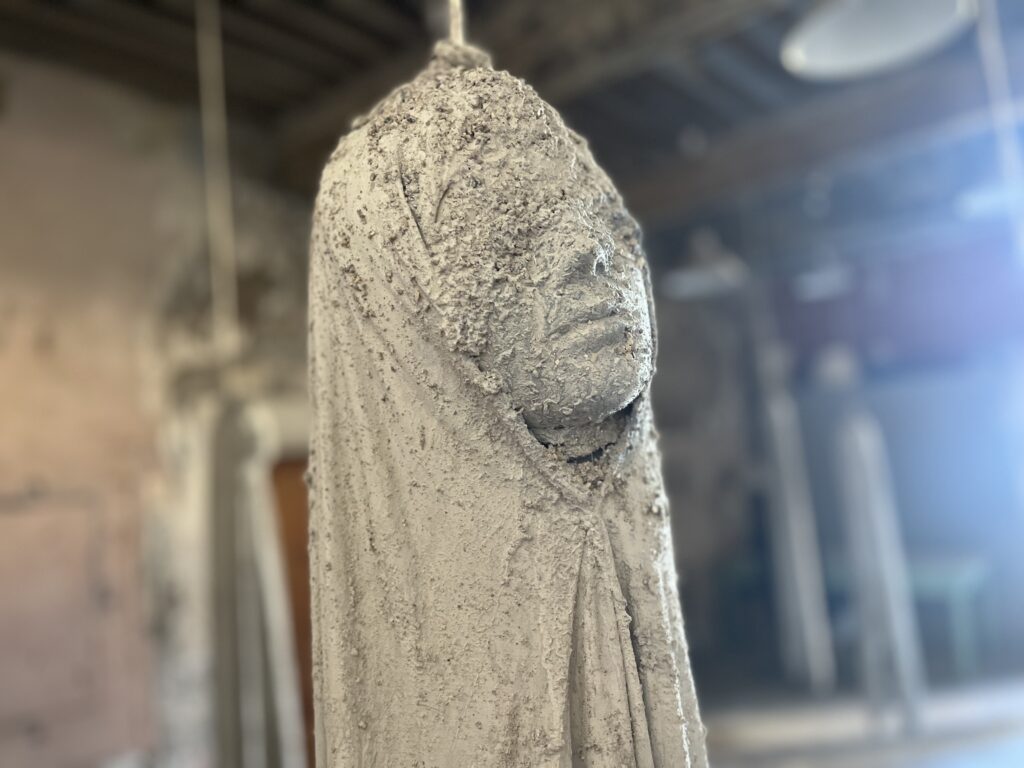
SETTING draws from both personal and collective experiences of women in Iran. The statues and the concrete-covered women’s faces represent what Sadaf Ahmadi has fought against throughout her life, and what she still sees in Iran today. The artwork conveys a sense of the isolation that Sadaf Ahmadi herself experienced, before she began to break free as a teenager. She describes the situation of women as a self-imposed prison and a disembodiment demanded of women who want to be considered appropriate and gain the advantages that come from submitting to the laws. This is also reflected in the absence of bodies, as women are denied the right to their bodies and identities.


Photos: Sadaf Ahmadi
This exhibition showcased 10 crafted concrete heads adorned with long veil-like hijabs. This artistic installation serves as a poignant expression of my early encounters with the political dimensions of mandatory hijab enforcement during my formative years in the 1990s. At the tender age of twelve, I began to grapple with the religious and ideological impositions surrounding hijab, a transition typically experienced by girls as they approach adulthood, often around the age of nine. However, my journey into religious observance had commenced four years earlier when I and my friends found ourselves compelled to participate in daily school prayers and adhere to a litany of regulation.